
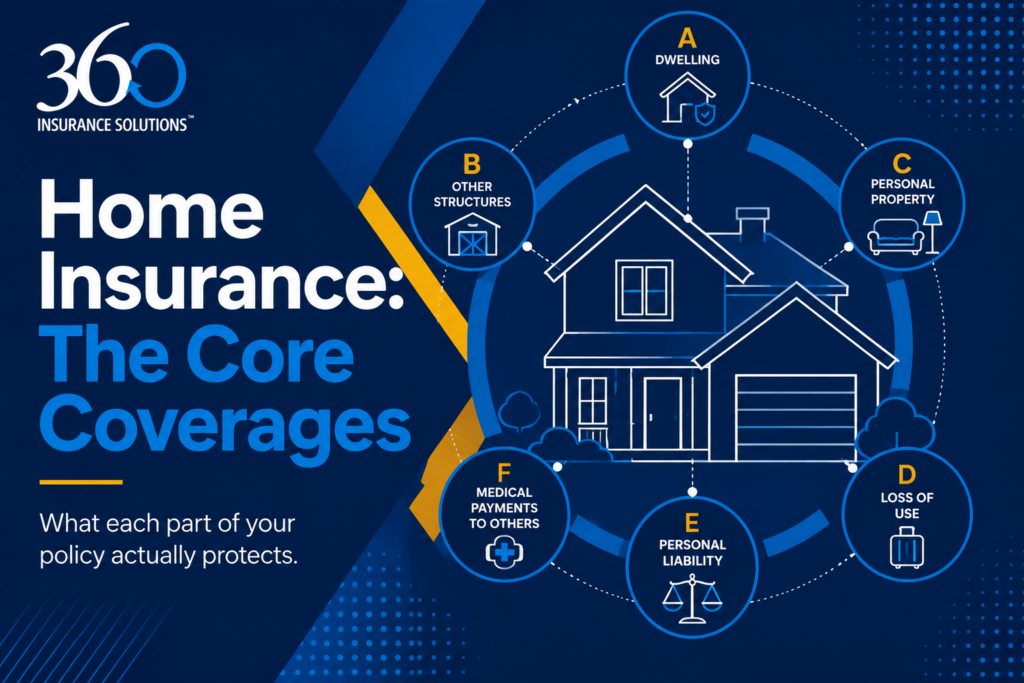
What’s On Your Home Insurance: The Core Coverages
If you’re comparing home insurance quotes, the good news is that the basics are standardized. Every insurer has to include the same core coverages on a homeowners policy, which means you’re not comparing apples to oranges on the fundamentals. The real differences between quotes is how much you get for each of those coverages then what shows up in the optional coverages and packages, which we’ll cover here. This one is about knowing what you’re already looking at.
Coverage A: Dwelling
This is the pot of money to repair your home or rebuild if it’s a total loss. The number that matters here isn’t what you paid for the house. It’s what it would actually cost to rebuild it today, plus debris removal, so you can tear down what’s left and start over. Cost of materials, labor, clean up, and demolition all factor into this one as opposed to market, or even tax values. Don’t shortchange this number. Without enough coverage here, you don’t get your home fully back.
This includes everything attached, including your countertops, cabinets, light fixtures, and even your deck. Basically, if it’s screwed/ bolted into place, it’s part of the Dwelling and gets coverage from this bucket.
Most policies also offer an add-on called Extended Replacement Cost, which extends this number further as a cushion. It shows up under optional coverages, but it’s worth flagging early: no matter how carefully your dwelling coverage is calculated, nobody gets it perfect every time, and this is the buffer for that.
Coverage B: Other Structures
A building or structure that is detached from the primary part of the house – a shed, a detached garage, a gazebo, a fence, pool; even a dock or a bulkhead if you’re on the water. If it’s not attached to the home, it falls here, not under dwelling.
This is most times 10% or 20% of your Dwelling limit, but if you need more, it’s easily increased, most times.
Coverage C: Personal Property
Simply put, your belongings. Furniture, electronics, clothing, and yes, the smaller stuff too. Picture frames, candlesticks, toiletries. People consistently underestimate this category because they think in big-ticket items, but the small stuff adds up faster than expected, and every claim we’ve handled has confirmed that.
This coverage also follows you off the property. Luggage stolen on vacation, items in your car, belongings in off-site storage. There are limits to what’s covered off-premises, but it’s broader than most people assume.
Coverage D: Loss of Use
This is what pays for somewhere else to live if your home becomes uninhabitable during repairs. It covers a hotel and increased food and travel costs for a short-term issue, and can extend to a full rental home or even furniture rental if the rebuild is long-term. Whether a repair situation counts as “uninhabitable” depends on severity, so this isn’t automatic for every claim, but when it applies, it matters a lot.
Your Deductible
Your Deductibles is the part of damages you pay for before coverage kicks in. And if a claim is filed, most times it is withheld from the payout from your policy.
But deductibles have gotten more complicated. Some policies carry a separate, higher deductible for wind, hail, or hurricane damage, and it’s easy to miss this if you’re not looking for it specifically.
Two things to check:
- Can you actually afford the deductible? If damage is at or slightly above your deductible, you likely won’t file a claim, so the number needs to be realistic for your situation.
- Is it a flat dollar amount or a percentage? A “2% Wind and Hail deductible” sounds small, but it’s 2% of your Coverage A: Dwelling limit, not 2% of the claim. So on a $500,000 dwelling limit, that’s a $10,000 deductible. Read this carefully so you can be ready.
Coverage E: Personal Liability
This covers injuries you cause to other people, with some exclusions (vehicles and business activities being the main ones). If someone gets hurt at a party you’re hosting, or you hit a pedestrian while riding a bike, this is your defense, covering their injury and damages if you’re at fault.
It reads like it’s protecting someone else, but it’s really protecting you from a lawsuit. This is inexpensive coverage to increase, so we generally recommend starting at $500,000 rather than the policy minimum.
Coverage F: Medical Payments to Others
Similar to liability, but fault doesn’t matter here. If someone is injured on your property, regardless of who caused it, this coverage can pay their medical bills directly, up to the policy limit. We recommend at least $5,000.
A common real-world example: someone helping you cook cuts their finger with a knife. You didn’t cause it. But if they don’t have health insurance and need help with the bill, this is the coverage that steps in, no fault determination or lawsuit required.
The Bottom Line
Every insurer is required to include Coverages A through F. The comparison shopping happens on the limits and deductibles you choose within them, not on whether they exist. Get comfortable with what each one actually does, and the rest of the quote gets a lot easier to evaluate.